Aurora Dashboard on Aurora Alerts app
Aurora Dashboard on Aurora Alerts app.
Name on Apple App store: Northern Lights Aurora Alerts
Name on Google Playstore: Aurora Australis Alerts & Sout
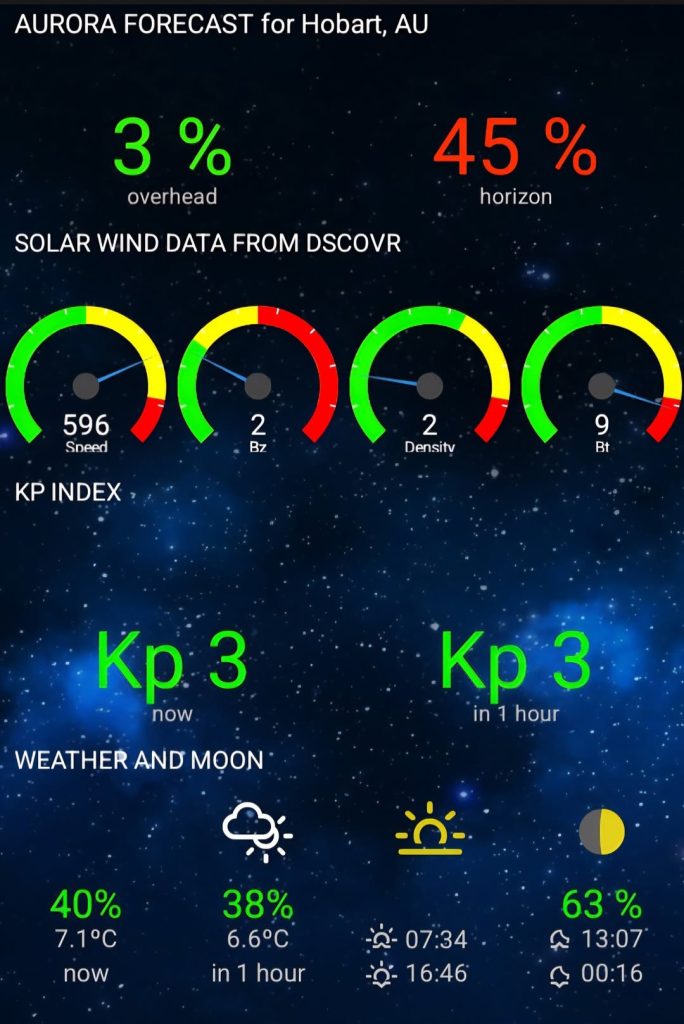
Here are 4 key values on the dashboard and what they mean.
Bz – The Aurora Doorway
Bz is the most important factor when it comes to auroras. It’s the z-component of the sun’s magnetic field. When Bz turns negative, it means the solar wind can easily connect with Earth’s magnetic field—like opening a door to transfer energy. The more negative Bz gets, the more energy flows in, increasing geomagnetic activity. If Bz stays negative for a long time—and especially if it’s strongly negative—get ready for a spectacular aurora show!
Wind Speed – The Solar Wind’s Punch
The faster the solar wind, the harder it hits Earth’s magnetic shield. Higher speeds mean a stronger impact, which can disturb our magnetosphere and trigger auroras. Normally, solar wind travels at about 300 km/s. But during intense solar events like coronal holes, it can ramp up to 500–750 km/s, packing a serious punch.
Bt – Magnetic Field Strength
Bt measures how strong the magnetic field is in space, recorded by the ACE satellite. It reflects the tug-of-war between Earth’s magnetic field and the magnetic energy in the solar wind. Imagine a cloud of charged particles from a solar explosion (CME) flying by Earth—those particles carry magnetic force, and Bt tells us how intense that force is.
Density – How Crowded the Solar Wind Is
This measures how many particles are packed into the solar wind. More particles mean more chances for them to slam into Earth’s magnetic field, increasing the chances of seeing auroras. It’s measured in particles per cubic centimeter (p/cm³), and if the number goes above 10, the solar wind is considered very dense—and aurora potential goes up!