What Is the Aurora Oval? Understanding the Auroral Zone for Better Southern Lights Chances
Ever wondered why some people get a front-row seat to the Southern Lights (or Aurora Australis) while others barely catch a flicker? It’s not just about luck but about where you’re standing. Enter the Aurora Oval, the cosmic sweet spot for those dazzling light shows that have us staring at the sky like excited kids.
So, what exactly is the Aurora Oval, and how can understanding it boost your chances of seeing the Southern Lights? Let’s dive into the fun, spacey details!
The Aurora Oval: The VIP Section of the Sky
Picture this: the Earth is like a giant disco ball spinning in space, and it’s constantly being hit by streams of charged particles (thanks, solar winds!). Now, instead of these particles lighting up the entire planet like a glow stick, they’re attracted to the poles because of Earth’s magnetic field. And voilà, when they slam into the atmosphere near the poles, we get the spectacular light show we call the Aurora.

Here’s the key: these light shows don’t happen randomly everywhere. They mainly occur in an oval-shaped ring around the magnetic poles—the Aurora Oval. It’s basically the Earth’s built-in theatre for the auroras, and if you’re in or near this zone, you’re much more likely to see them.
How the Aurora Oval Affects Your Southern Lights Experience
For the Southern Hemisphere, the Aurora Australis puts on its show closest to Antarctica and the surrounding southern oceans. However, when you understand the Aurora Oval, you can increase your chances of catching the lights by getting as close to its path as possible. Unlike a regular oval, the Aurora Oval is not a perfectly fixed shape—it moves and stretches depending on how strong solar activity is at any given time. During high solar activity (often measured by the Kp index), the oval expands, and auroras can be visible further from the poles.
On a quiet night, the Southern Lights are mostly visible from Antarctica or the southern tip of New Zealand. But during a solar storm? The aurora oval can expand, meaning places further north might catch a glow, too. Understanding this “breathing” of the auroral oval helps you know when and where to go.
The Sciencey Bit (But in a Fun Way!)
Let’s break it down for your inner space nerd. The Aurora Oval exists because the Earth’s magnetic field isn’t a perfect sphere—it’s more like a stretched-out donut. When the Sun’s charged particles hit our planet, they get funnelled down towards the poles by these magnetic lines, which is why auroras tend to show up in a ring-shaped zone around the poles.
Here’s the fun part: the size and shape of the Aurora Oval change based on how angry the Sun is (a.k.a. how much solar activity there is). During a calm period, the auroras stick closer to the poles, but when the Sun’s throwing a cosmic tantrum—solar flares, coronal mass ejections, the works—the oval stretches and expands, sometimes letting people in lower latitudes catch a glimpse of the lights.
This is why watching solar forecasts can help you time your Southern Lights adventure just right. When the Kp index spikes, grab your gear and head south—you might catch the auroras dancing even in places that aren’t usually in the oval.
Best Spots to Catch the Southern Lights (Thanks, Aurora Oval!)
Since the Aurora Oval’s southern counterpart hugs Antarctica, your best bet for viewing the Southern Lights is as far south as you can go without falling into the icy waters! Some top spots include:
- Stewart Island, New Zealand – Located at the southern tip of New Zealand, this island is famous for clear, dark skies and offers a great chance to see the Southern Lights.
- The Otago Peninsula, New Zealand – Another Kiwi hotspot, the peninsula’s remote nature and low light pollution make it a great place to catch an aurora when the oval shifts northward.
- Tāhuna/Queenstown, New Zealand – If you want adventure and auroras, Queenstown’s mix of outdoor thrills and stunning night skies makes it a solid choice.
- South Georgia Island, Atlantic Ocean – This British Overseas Territory is remote. Still, it sits in the Aurora Oval zone, making it a prime viewing location (if you can get there!).
- Tasmania, Australia – Even though it’s a little further from the pole, Tasmania’s low light pollution and its proximity to the oval during solar storms make it a decent Southern Lights spot.
How to Know When You’re in the Zone
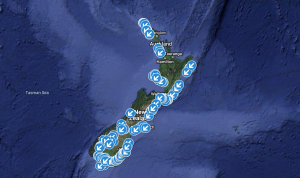
You can use real-time aurora maps or apps that track solar activity to know if you’re in the aurora’s hot zone. These tools often show where the Aurora Oval is and how likely you are to see the lights based on current geomagnetic conditions. The bigger the oval, the more people get to see the show.
And remember, clear skies and minimal light pollution are just as important. You might miss the magic even if you’re right under the oval, in the middle of a city with bright lights.
Final Tips for Your Aurora-Hunting Adventure
- Check the Kp Index: This magical number tells you how intense the solar activity is. For Southern Lights viewing, you’ll typically need a Kp index of 4 or higher, depending on your location.
- Go Dark: Find a spot with as little artificial light as possible. The darker your surroundings, the better your chances of seeing those dancing lights.
- Look South: It seems obvious, but always make sure you have a clear, unobstructed view of the southern horizon!