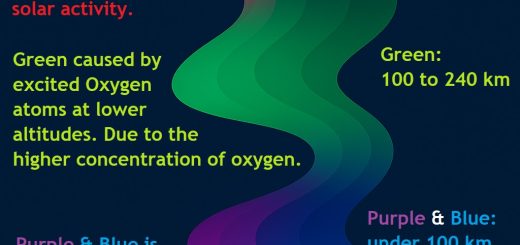
Why we see more of Red than Green Aurora in Australia and New Zealand
Why do Auroras at lower latitudes (Australia and New Zealand) look red and not Green like locations in the Northern Hemisphere?
Australia and New Zealand (except for the very south like Tasmania or Invercargill) are farther from the South Magnetic Pole than places like Tromso in Norway or Alaska are from the North Magnetic Pole. That means people here are usually looking up at the aurora from a long distance, rather than standing under it.
Red Light Is Higher Up in the Atmosphere:
Red aurora is caused by oxygen atoms at very high altitudes (above 200–300 km).
Green aurora also comes from oxygen, but at lower altitudes (around 100–200 km).
Because observers in Australia and NZ are seeing the aurora at an angle, near the horizon, they’re more likely to see the high-altitude red emissions. The green stuff is happening lower and farther away—often hidden below the horizon or lost in the curvature of the Earth.
Red Travels Better Than Green:
Red light scatters less than green or blue as it travels through the atmosphere.
So, from a long distance (like viewing aurora over Antarctica from Tassie), the red light has a better chance of reaching your eyes or camera than the green does.
In stronger geomagnetic storms, green aurora can still be seen from AUS/NZ, but for the average mild event, the red hues dominate.
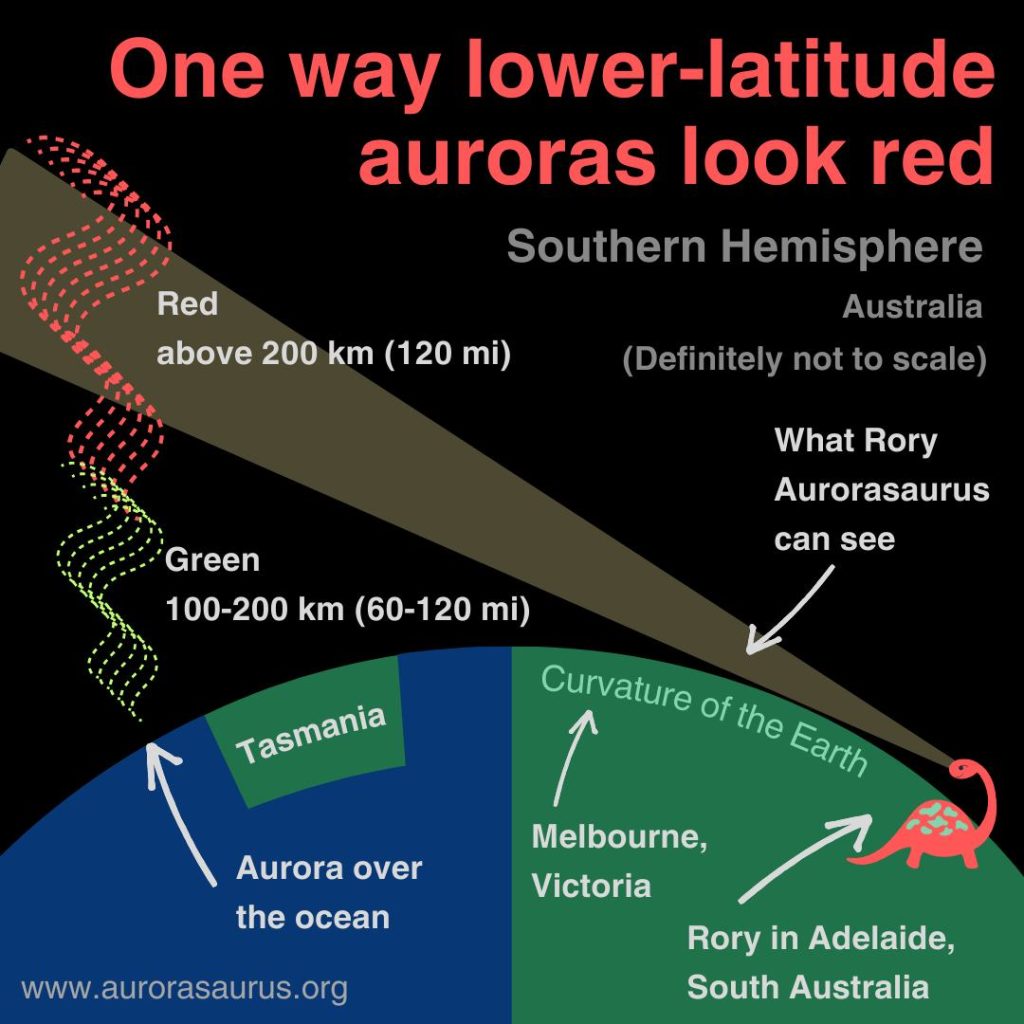
Image Credit: Aurorasaurus
In the bottom half of the image, a big curved shape represents the Earth. Rory Aurorasaurus, a red dino with a passion for sky shows, is standing in Adelaide, South Australia (on the right side of the curve). She’s looking south across the ocean, hoping to spot an aurora dancing above Tasmania, which is shown on the left side.
But here’s the catch: the curve of the Earth is in the way! Because of this, Rory can’t see the lower part of the aurora, where the green glow happens (about 100–200 km up). What she can see is the higher red glow that happens above 200 km. That’s why from places like Adelaide and Melbourne (which is also marked nearby), auroras often look red—they’re just peeking over the Earth’s horizon.