Lets talk Solar Flares: The Sun’s Epic Meltdown
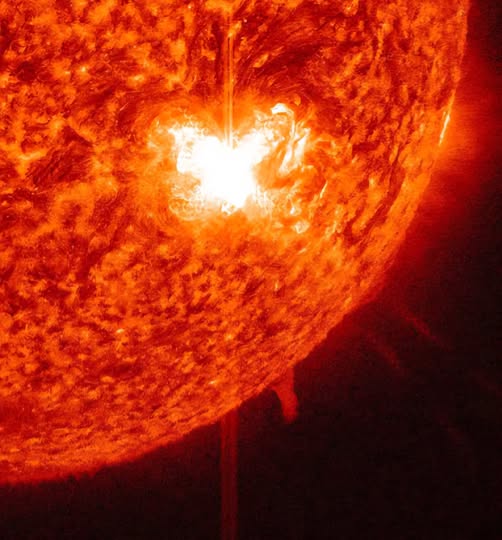
A solar flare is the Sun having a sudden, fiery freak-out. It shows up as a huge, bright flash on the surface.
Why does this happen? The Sun’s magnetic field lines get all twisted up like spaghetti, and when they snap… BOOM! Massive energy release.
This flare-up heats the Sun’s outer layer to millions of degrees and blasts out a mix of light, radiation, and high-speed particles in all directions.
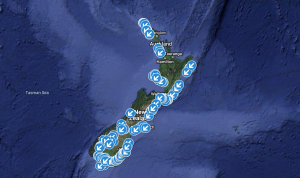
And the big ones? They’re so powerful, they could keep the lights on in Australia and New Zealand for a million years. Not that we’re asking the Sun to pay the power bill… but still.
Solar flares blasts out energy in all directions — X-rays, light, and a bunch of super-fast particles like electrons and protons flying through space like it’s a cosmic dodgeball game.
They usually pop off in rowdy parts of the Sun where the magnetic fields are extra strong — usually near sunspots, those dark little patches that act like cosmic troublemakers.
When those magnetic fields get too twisted and tangled (imagine a bunch of angry noodles), they finally snap like a rubber band — and boom — the Sun lets out a giant energy burp.
Solar flares come in sizes — like space weather snacks. They’re ranked by letters:
B is baby-sized,
C is calm-ish,
M is medium mayhem, and
X is… uh-oh.
Each letter is 10 times stronger than the one before. So an X flare is basically a C-flare that hit the gym and drank five energy drinks.
Inside each letter class, there’s a scale from 1 to 9 — like a spiciness rating, but for solar chaos.
C-class flares: Too weak to bother Earth. The Sun sneezed, we blinked.
M-class: Can mess with radio signals at the poles and give astronauts a rough day.
X-class: These are the Big Boss flares. They can fry satellites, mess with power grids, and even give airline passengers near the poles a tiny space suntan.
And get this — even though X is the last letter, the flare party doesn’t stop at X9. In 2003, the Sun let out a flare so huge, it broke the measuring tools. They tapped out at X17, but it was later guessed to be around X45.
Solar flares come in two moods: short and snappy, or slow and dramatic — just like humans on Mondays.
Impulsive Flares = The Sun’s quick tantrum
These are short, fiery outbursts — over in less than an hour. Fast, furious, and intense. Like the Sun stubbed its toe and screamed real loud.
Long-Duration Flares (LDEs) = The Sun’s slow burn
These ones drag on for hours — the Sun’s version of a dramatic soap opera. They release energy more slowly but can cover a huge area.
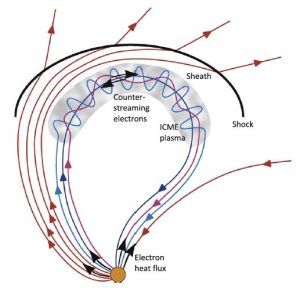
Now throw in CMEs (Coronal Mass Ejections) — which are like the Sun flinging a giant plasma pie across space. They sometimes show up with flares, especially the long, dramatic ones. But not always!
Some X-class flares can be fast and furious, while others are long, slow, and full of flair. CMEs from short flares are like narrow laser blasts. CMEs from long flares? More like a wide cosmic sneeze.