Sunspot Classification
Let’s talk sunspot regions and how they get classified — using AR 4087 as an example. This pic is from May 15, 2025 and this region has now rotated out of our view.
A few months ago, I came across a great explanation about sunspots by Christopher Mathews. I used what I learned from that and applied it to AR 4087, aiming to provide you with a comprehensive understanding of this fascinating solar phenomenon.
First things first—what’s AR 4087?
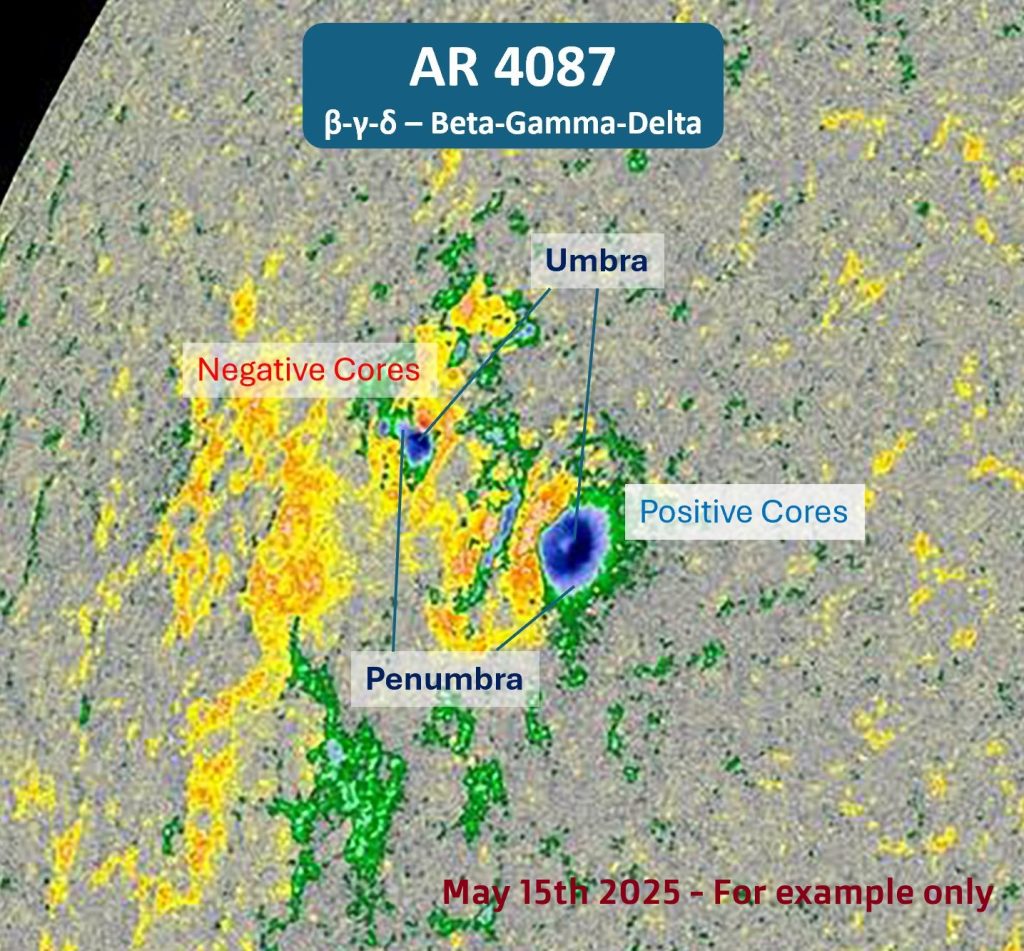
“AR” stands for Active Region, and 4087 is just its number—like a solar license plate. Sunspots hang out in these active zones, where the Sun is throwing a bit of a magnetic tantrum.
What’s in the image?
The image comes from NASA’s Solar Dynamics Observatory (aka space paparazzi for the Sun). It uses a tool called HMI, which takes fancy magnetic field selfies.
In the image:
Yellow areas = negative magnetic energy
Green areas = positive magnetic energy
These zones are called plages (say it like “plahzh”)—they’re bright, busy patches where stuff might be happening soon. Kind of like the suburbs before a big sunspot moves in.
Now, where it gets serious:
When magnetic fields bunch up, they form what we call magnetic cores.
Red blobs = negative core
Blue blobs = positive core
Each core has a dark centre (the umbra), and a lighter edge called the penumbra (basically, the solar fringe).
So what was going on with AR 4087?
Well, it was messy.
It had both red and blue cores hanging out.
Some were right next to each other, like grumpy neighbours sharing a fence.
In fact, one positive and one negative core were so close, they were sharing the same penumbra—solar roommate situation!
This magnetic madness earned AR 4087 a top-tier classification (β-γ-δ):
Beta (β) – opposite types of cores
Gamma (γ) – they’re all jumbled and chaotic
Delta (δ) – opposites literally overlapping
Sunspots like this are the drama queens of the Sun. They can launch huge solar flares, including the powerful X-class kind.
Because those tightly packed magnetic fields are just itching to snap—and when they do, BOOM
It’s not how big the sunspot is that causes flares… it’s how messy and stressed out the magnetic fields are. Kind of like people. Now we wait for the next β-γ-δ sunspot region.
Current Sunspot regions with classification:
AR4099 – β
AR4100 – β-γ
AR4105 – β-δ
AR4106 – β