Take on Kp Index
What is Kp Index?
Think of the Kp index as Earth’s “mood metre” for space weather. It tells us how rowdy the Sun’s solar storms are and how much they’re messing with Earth’s magnetic field.
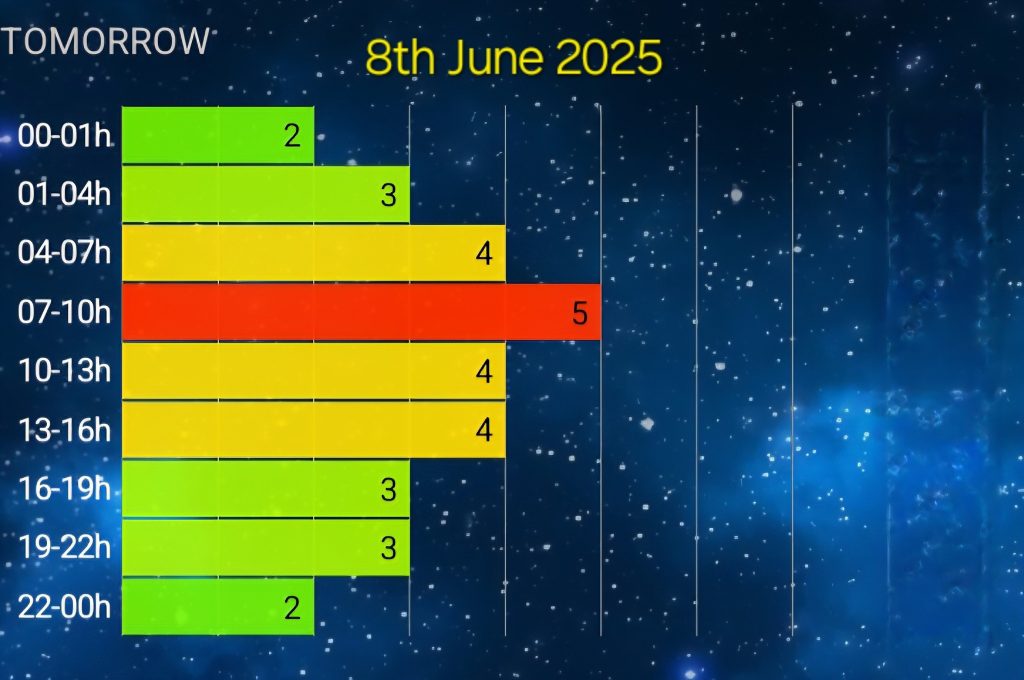
It goes from 0 to 9 —
0 means the Sun’s behaving,
9 means it’s throwing a wild party in space.
Kp index: Not your instant noodles.
Kp is like a group chat between space weather stations all over the world. Each one shares how shaky Earth’s magnetic field feels in their area, and then we average it out to get the Kp score.
But here’s the catch — it’s not real-time. It’s more like a “what just happened” report.
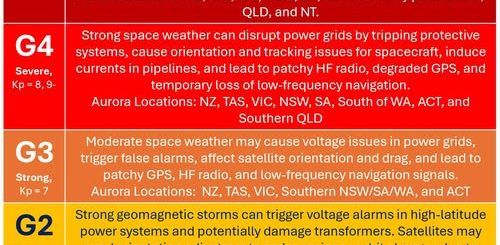
When the Kp index gets higher, it means the Aurora might shimmy its way further up (further down) the map from the poles — showing up in places that normally don’t get a front-row seat. Even spots that usually miss the party (NSW, South QLD) might get a surprise glow-up during big geomagnetic storms.
That’s why NOAA (the space weather nerds) keep a close eye on it — they use Kp to send out alerts and warnings so people (and satellites!) know when space is acting up.
Pitfalls on Kp Index:
The Kp index is like a 3-hour weather summary — helpful, but not great if you’re trying to catch a 5-minute aurora flash. It’s a global average, which means it can miss local drama. Just because the Kp looks promising doesn’t guarantee a light show in your backyard — things like clouds, light pollution, and where you are also play a huge role. And while Kp gives a rough idea of how far south (or north) the aurora might stretch, it’s not a GPS. It’s more of a helpful guess than a precise prediction.
Kaus: Australia’s personal space weather gossip.
Kaus is the Aussie version of the Kp index — you’ll find it on the BOM Aurora page. It’s a local estimate of geomagnetic activity just for our region, thanks to the space weather team at SWS.
The best part? It updates roughly every 5 minutes, so it’s basically giving you near real-time aurora intel — faster than your group chat replies.
How I use the Kp Index (a.k.a. my pre-Aurora checklist):
I keep an eye on NOAA’s 3-day Kp forecast — it’s like a space weather heads-up. It’s rarely spot-on (bless their hearts), but it helps me prep: charge the camera, charge myself (with snacks), and scout clear skies just in case all numbers align for a chase.
Next, I check the WSA-ENLIL solar wind model to see when a CME might smack into Earth, and peek at the ACE EPAM for early signs it’s on the way.
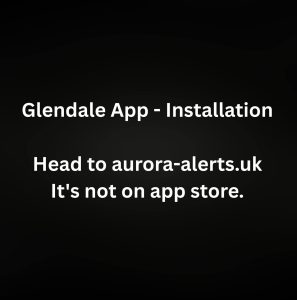
But here’s the truth — we only know it’s really happening when the DSCOVR satellite picks up the incoming storm. That’s when the real data flows in — via apps like Glendale or SpaceWeatherLive.
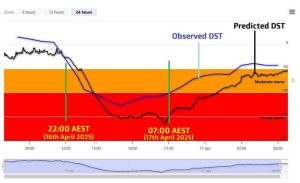
Once the numbers start moving, I dive into the details: solar wind speed, density, Bt, Bz, hemispheric power, Dst index. After the impact hits? I stop caring about Kp. You can have a Kp of 8, but if Bz is pointing the wrong way? No lights, no party.