Let’s Talk About CMEs
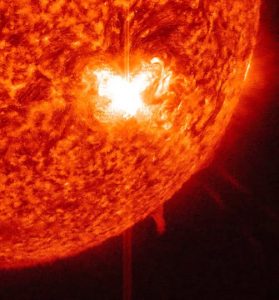
A CME, or Coronal Mass Ejection, is when the Sun throws a big tantrum. It suddenly blasts out a huge blob of hot gas and energy, kind of like the Sun sneezing super fast spaghetti into space — nearly 3,000 km every second!
Sometimes this space sneeze happens after a solar flare , but can happen at other times as well.
The Sun has magnetic loops — like invisible rubber bands made of fire. When these loops twist too much and snap, they throw a chunk of hot, messy stuff out into space.
What Does a CME Look Like?
A CME looks like a big, hot balloon full of energy and tangled strings. Scientists call it a “flux rope” (just a fancy word for a magnetic blob).
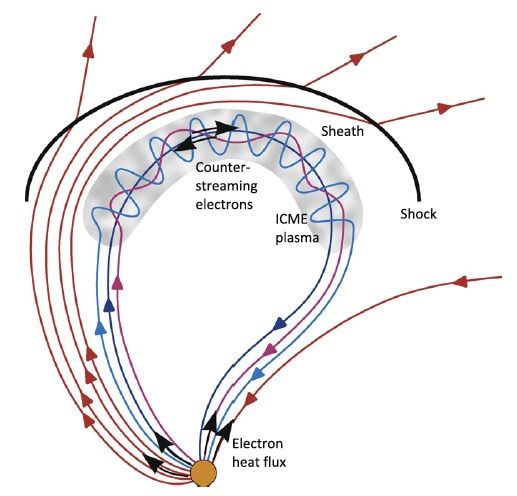
The Diagram:
1) The Sun (the little yellow circle)
That’s our Sun. It’s the one that throws the big energy blob.
2) Electron Heat Flux
Those blue and black arrows? That’s the first burst of fast energy flying out — like a big “whoosh!”
3) ICME Plasma (The Main Blob)
This is the main part of the CME. It’s like a balloon filled with hot gas and tangled magnetic strings. If it hits Earth, it can mess with tech or cause auroras.
4) Counter-streaming Electrons
Inside the CME balloon, little particles bounce back and forth, like they’re playing ping-pong in space.
5) Sheath (Messy Zone)
Before the main CME blob arrives, it makes a stormy area in front — kind of like waves in front of a speeding boat, but in space.
6) Shock (The First Slam)
The CME is moving so fast it makes a shockwave, like a boom in space.
Apps like Glendale will say “Interplanetary Shock Detected” — which just means “The Sun’s big blast is almost here!”
7) Magnetic Field Lines
These red and blue lines are like power cords made of magnetism (the likes of Bz, Bt, etc). Sometimes they connect with Earth’s magnetic field, and when they do — BAM! We get auroras lighting up the sky – like the ones we got a few days ago.